Clinical studies show CPAP is the most effective treatment for obstructive sleep apnea (OSA), but it isn’t always the right fit for everyone. Oral appliances offer a proven alternative for mild-to-moderate OSA or for those who cannot tolerate CPAP. Careica Health’s sleep specialists review each patient’s sleep study results and weigh OSA severity and lifestyle factors to recommend the best-fit therapy.
What is CPAP therapy?
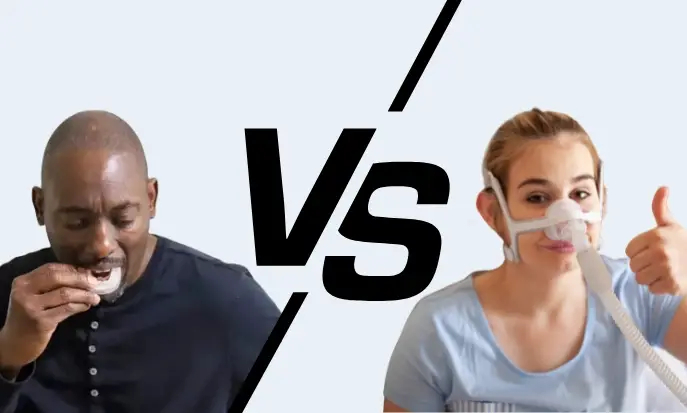
Continuous positive airway pressure (CPAP) therapy uses a machine to deliver a steady stream of pressurized air through a mask, keeping your airway open throughout the night. It’s considered the gold-standard treatment for OSA because it physically keeps your airway open, which ensures you do not stop breathing while you sleep.
The tradeoff is tolerance. Many people can find the mask, hose, and airflow uncomfortable when they start therapy. Most early side effects (dry mouth, mask leaks, a feeling of claustrophobia) can be resolved through mask refitting, humidification, or pressure adjustments, so a tough first few weeks doesn’t automatically mean CPAP is the wrong choice.
What is oral appliance therapy?
An oral appliance is a custom-fitted mouthpiece, similar in size to an athletic mouthguard, worn during sleep. They work by gently holding your lower jaw forward, which pulls the tongue forward as well and creates an opening in the airway.
Oral appliances are generally recommended for mild-to-moderate OSA rather than severe cases. A 2019 editorial in the Journal of Dental Sleep Medicine notes that custom-made devices consistently outperform over-the-counter “boil and bite” versions in both comfort and effectiveness.
They can also reduce snoring on their own, even without a formal OSA diagnosis.
How do CPAP and oral appliances compare?
CPAP outperforms oral appliances on clinical measures of OSA severity, but oral appliances can be more comfortable for some people which improves their nightly compliance. A 2025 JBI umbrella review of oral appliance therapy found the two options comparable on other outcomes, including daytime sleepiness and blood pressure improvement.
The table below compares both options across effectiveness, patient fit, comfort, and daily use.
| Factor | CPAP | Oral Appliance |
|---|---|---|
| Effectiveness | Most effective option for reducing apnea events | Effective for mild-to-moderate OSA; less effective than CPAP on objective measures |
| Best candidate | Moderate-to-severe OSA | Mild-to-moderate OSA, or snoring |
| Comfort & compliance | Lower reported comfort and nightly compliance, though newer masks and machines are smaller and more comfortable | Higher reported comfort and nightly compliance |
| Travel & daily use | Requires power source, tubing, and mask | Silent, portable, no power needed |
| Maintenance | Nightly mask and tubing cleaning | Daily rinsing, similar to a retainer, plus periodic dental check-ins for bite changes |
Patient preference plays a bigger role than data alone might suggest. A 2013 editorial in SLEEP notes that 30-50% of CPAP users who become non-adherent over time typically cite comfort and noise, not a lack of effectiveness, as the reason. Because real-world treatment outcomes depend on adherence, a patient who reliably wears an oral appliance every night can end up better rested than one who owns a more “effective” CPAP machine but rarely uses it.
Which treatment is right for you?
There’s no universal answer. The right therapy depends on OSA severity, jaw and airway anatomy, mask tolerance, and whether CPAP has already been tried. The first step is a sleep study to determine if you have OSA and, if so, at what severity.
Our registered respiratory therapists and sleep specialists evaluate all these factors with every patient, rather than a one-size-fits-all approach. For patients who could not tolerate CPAP, or whose sleep study points to mild-to-moderate OSA, an oral appliance is often discussed as a legitimate primary therapy.
Frequently asked questions
Is oral appliance therapy as effective as CPAP?
For mild-to-moderate OSA, oral appliance therapy can approach CPAP’s real-world effectiveness, largely because patients use it more consistently than CPAP. For moderate-to-severe OSA, CPAP remains the more effective option overall and is generally the first treatment recommended.
Can I switch from CPAP to an oral appliance?
Yes, provided a sleep specialist confirms your OSA severity and deems you a good fit for the device. Patients with mild-to-moderate OSA, and/or who can’t tolerate CPAP, are good candidates for a custom oral appliance.
Are oral appliances and CPAP covered by insurance?
Most extended healthcare plans cover a percentage of both CPAP and oral appliance therapy. Oral appliance therapy is typically classified as medical rather than dental, so it’s often covered even without dental benefits. Careica Health will contact your insurer to confirm coverage details and offers payment options if you don’t have extended coverage
Talk to a sleep specialist
If CPAP hasn’t worked for you, or you’re newly diagnosed and weighing your options, the next step is a conversation with a sleep specialist who can match a treatment to your therapy needs and lifestyle. We can review your sleep study results, walk through CPAP and oral appliance options, and help you find the therapy you’ll be able to stick with.
CareicaHealth.com | 1-888-297-7889