
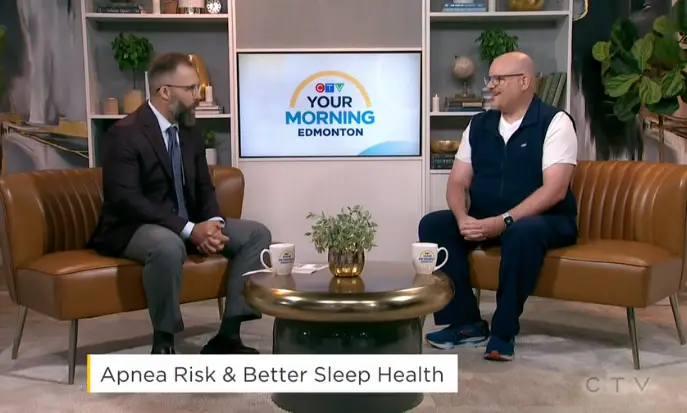
A good night’s sleep shouldn’t be out of reach, but for a lot of us, it is. About 30% of Canadian adults are at intermediate or high risk for having obstructive sleep apnea, a condition that can lead to serious health issues if it goes untreated. Andrew Hoskins, a Registered Respiratory Therapist with Careica Health, joined CTV’s Your Morning Edmonton to break down what sleep apnea actually is, how to spot the warning signs, and what treatment options are out there.
What’s the difference between snoring and sleep apnea?
Snoring is often the first sign that sleep apnea could be developing. As Andrew explains:
"Snoring is kind of a first indicator that you could have some apnea going on, because it's a mild closure of the airway, and then it basically reverberates, and that's what gives you the snoring sound. But apnea is actually when you have a blockage in your airway. So the muscles relax enough that your airway closes, and then you're not able to get in the air, and as your oxygen level goes down, your brain says, 'Hey, we need oxygen to breathe.' So subconsciously it wakes you up enough to pop your airway open."
Andrew Hoskins, RRT
What are the signs you might have sleep apnea?
A few things are worth paying attention to. Andrew points to some clear indicators:
"There's a few things to look for. One, obviously, is snoring. The other one is if you have a bed partner, if they're doing the old elbow to make sure you're breathing, that's a good one. If you wake up and you just don't feel like you've had a good sleep, or you have daytime fatigue... another one that's really important in women is morning headaches. If they're finding that they're tired, but they're having that morning headache, that's a good indication to get some more testing done."
Andrew Hoskins, RRT
If any of these sound familiar, it’s worth looking into a sleep study.
What treatments are available for sleep apnea?
CPAP remains the gold standard, but it’s not the only option. Andrew walks through what’s available:
"There's actually a bunch right now. The gold standard treatment is definitely CPAP, which is, you wear a mask which gives a light flow of air, and it basically splints your airway open. And as long as your airway is open, your oxygen level stays fine, you get a better sleep. There's also an oral appliance, which basically kind of looks like Invisalign, and what it does is it shifts your bottom jaw forward to open up that airway a little bit. Then there's lots of things now that they're talking about, you know, Zepbound and things that are kind of additive into what would be the treatment. But the main one still is CPAP."
Andrew Hoskins, RRT
Can GLP-1 medications help treat sleep apnea?
It’s a fast-growing area of interest, and Andrew is candid about both the promise and the limits:
"It can definitely help. It's one of these things that is just expanding now, and you're seeing more and more things where they're saying that this is a treatment for sleep apnea. I think it can be an adjunct therapy to what you would normally do, which is CPAP. So in the testing that they've done, they've shown that about 24% of people who do have sleep apnea can get enough of a reduction that they don't need the CPAP. But that leaves 76% of other people that aren't being fully treated. So it's definitely a thing that will help, but sleep apnea isn't only weight based. And because there's so many different variations and phenotypes with it, you just have to make sure that we get you on the right therapy."
Andrew Hoskins, RRT
Does mouth taping help with sleep apnea?
Mouth taping has become a popular trend online. Andrew’s take:
"Mouth taping, again, in conjunction with CPAP, can be really great. Sometimes when you have those people who are just wearing a nasal mask or something along those lines on the CPAP, but they still can't keep their mouth closed, the mouth tape actually will help so that they're still getting their therapy. Doing mouth taping on its own, you're just teaching yourself to breathe through your nose, but I haven't seen anything that actually shows that it corrects any sleep apnea, where the reduction is happening."
Andrew Hoskins, RRT
Are you struggling with sleep apnea?
Sleep apnea is common, often overlooked, and, importantly, treatable. If snoring, fatigue, or morning headaches sound familiar, it may be worth exploring further with a sleep study.