

If you’ve been struggling with sleep for weeks, months, or even years, you’ve probably tried a few things already. Maybe you cut back on caffeine, downloaded an app, or picked up some melatonin at the pharmacy. And maybe some of it helped a little, for a little while. But nothing really felt like it worked.
You’re not alone. In Canada, about 16% of adults meet the criteria for insomnia disorder, and nearly half the population reports regular trouble falling or staying asleep. It’s one of the most common health issues out there, and it responds well to the right treatment.
That treatment is called CBT-I.
What is CBT-I?
CBT-I stands for Cognitive Behavioural Therapy for Insomnia. It’s a structured, evidence-based program that gets to the root of why you’re not sleeping – the habits, the routines, the thoughts that keep your brain wired at night – and systematically changes them. No medication required. It’s what major sleep medicine organizations recommend as the go-to treatment for chronic insomnia, ahead of sleeping pills.
CBT-I is built on five components that all work together:
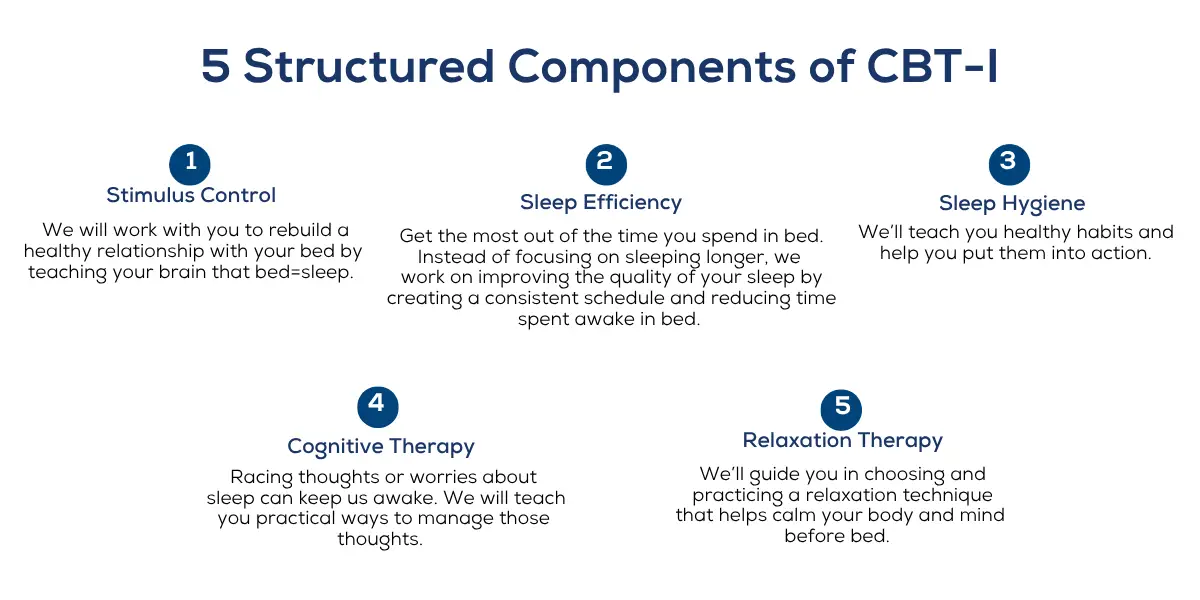
Some of these might sound familiar, but if you’ve tried the usual advice and you’re still not sleeping, that’s kind of the point. Tips alone don’t fix chronic insomnia. CBT-I works because it combines all five components into something more targeted. 70 to 80% of people who complete a CBT-I program report significant improvements in their sleep.
It takes work. That's what makes it last.
CBT-I takes real effort. That’s worth being upfront about. The first few weeks can actually feel harder before they feel better. Time in bed restriction, one of the most effective components of CBT-I alongside stimulus control, temporarily limits the time you spend in bed to rebuild your natural sleep drive. That often translates to more daytime tiredness early on. It passes, but that doesn’t mean it’s fun while it’s happening. It’s also worth noting that time in bed restriction isn’t appropriate for everyone – certain underlying conditions may require a different approach, which is something your therapist will assess with you.
A meta-analysis of 20 clinical trials found that CBT-I cut the time it takes to fall asleep by an average of 19 minutes and reduced middle-of-the-night wakefulness by 26 minutes. Those improvements held at 12-month follow-ups – well beyond when the program itself ended.
The research shows that success with CBT-I is most often built on readiness and willingness to stick with the program. The effort is real, and so are the results.
Why apps alone aren't enough
There are plenty of sleep apps out there, some built on solid CBT-I principles. But research shows up to 40% of people who start a self-guided program don’t finish it. The biggest reasons: life gets busy, it’s hard to pick back up after missing a few days, and the whole thing feels kind of impersonal.
That makes sense. CBT-I asks you to change behaviours you’ve had for years while running on less sleep than usual. When the only accountability you have is a push notification, it’s easy to let things slide. And automated feedback telling you that you slept poorly, something you were already well aware of, can actually ramp up anxiety around bedtime rather than help.
An app can deliver information, but it can’t look at your sleep data and figure out why last week went sideways. It can’t tell you whether what you’re feeling in week two is normal or a sign that something needs adjusting. That’s what a therapist does.
Real therapists, real support
This is where Careica Health’s digital CBT-I program is different. You get the convenience of an app-based program with a dedicated, registered therapist behind it – Registered Social Workers and Psychotherapists who review your data, answer your questions, and adjust your plan as you progress.
Research shows that digital CBT-I can be just as effective as one-on-one therapy for many people. For those who need more hands-on support, stepping up to one-on-one sessions is always an option.
You work through the program on your own time and message your therapist through the app whenever you need to. The program runs about eight weeks – the first week or two focuses on collecting your sleep diary data, which your therapist uses to build your initial treatment plan. Active treatment runs about six weeks from there, and your therapist is monitoring throughout, so adjustments happen as you go rather than after the fact.
Your insomnia therapy may also be covered under extended health benefits if your plan includes psychotherapy or registered social worker services, and it qualifies for most health spending accounts.
Get started
If poor sleep has been hanging around too long, it might be time to do something about it. Book a free discovery call with Careica Health and find out if insomnia therapy is right for you.
CareicaHealth.com | 1-888-297-7889